• Contact Us

    +1(302)231-1850

  • Visit Our Place

    1207,DELAWARE AVE UNIT 2877, WILMINGTON, DE 19806
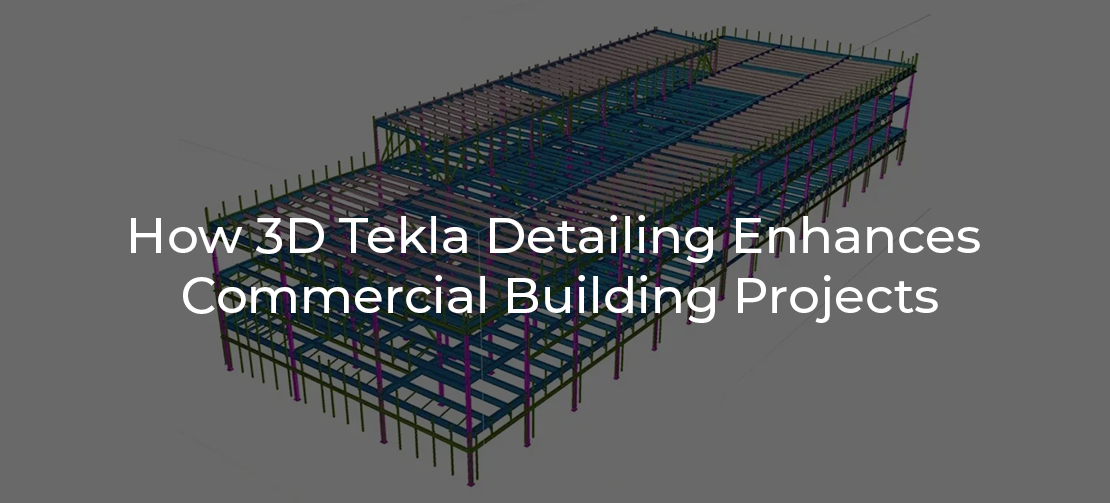
How Can 3D Tekla Detailing Improve Commercial Building Projects?

In today’s fast-paced construction industry, commercial building projects are becoming increasingly complex. From high-rise offices to shopping malls, the demand for precision, efficiency, and coordination has never been higher.

This is where 3D Tekla detailing comes into play, offering a transformative approach to structural steel and concrete detailing that ensures projects are delivered on time, within budget, and with minimal errors.

Understanding 3D Tekla Detailing

3D Tekla detailing is a specialized process using Tekla Structures software to create precise three-dimensional models of steel, concrete, and other structural components. Unlike traditional 2D CAD methods, which often rely on flat drawings, Tekla provides an intelligent 3D model that can be used throughout the project lifecycle. This includes fabrication, assembly, and even on-site construction. Its compatibility with BIM (Building Information Modeling) systems allows engineers, architects, and contractors to collaborate efficiently, reducing miscommunication and costly errors.

Key Advantages of 3D Tekla Detailing in Commercial Projects

The adoption of 3D Tekla detailing offers multiple benefits for commercial building projects. First, it significantly improves accuracy, ensuring that every beam, column, and connection fits perfectly. Clash detection is another critical advantage, allowing potential conflicts between structural, MEP, and architectural elements to be identified before construction begins. Additionally, Tekla facilitates better collaboration among stakeholders, streamlines fabrication through automated shop drawings, and reduces project timelines and costs by minimizing rework and material wastage.

How 3D Tekla Detailing Supports Complex Designs

Commercial structures often feature intricate steel layouts, multi-level floors, and large-span frameworks. 3D Tekla detailing allows project teams to visualize these complexities in a single, cohesive model. Architects and engineers can assess design feasibility, while fabricators can generate precise material lists and CNC codes for automated production. The table below summarizes the efficiency gains for different project stages when using Tekla:

Summary Table

Project Stage Traditional Detailing 3D Tekla Detailing Benefits
Design Verification Manual review Automated clash detection and accurate visualization
Fabrication Planning Manual drawings Precise material lists and CNC-ready outputs
On-site Assembly Potential errors Reduced errors and faster installation
Project Collaboration Multiple revisions Real-time updates and stakeholder coordination

Return on Investment (ROI) and Efficiency Gains

The implementation of 3D Tekla detailing has tangible financial and operational benefits. Projects utilizing Tekla often experience reduced labor costs due to fewer onsite corrections, lower material wastage, and faster approvals from stakeholders. While initial training and software investment are considerations, the long-term savings and improved quality of construction make Tekla a highly valuable tool for commercial building projects.

Challenges and Considerations

Despite its benefits, 3D Tekla detailing requires skilled professionals who understand both the software and construction processes. Teams must be trained to create and manage complex models effectively. Additionally, investing in compatible hardware and software licenses is necessary to fully leverage the capabilities of Tekla.

Future Trends in 3D Tekla Detailing

The future of commercial building projects is increasingly digital. Innovations such as AI-driven automation, cloud-based collaboration, and sustainable material optimization are becoming integral to Tekla detailing. These advancements will enable even larger and more complex projects to be executed efficiently, with improved accuracy and reduced environmental impact.

Conclusion

3D Tekla detailing is no longer an optional tool for commercial construction—it is a critical component that enhances accuracy, reduces errors, streamlines fabrication, and fosters collaboration. For construction companies, engineers, and architects aiming to deliver high-quality commercial projects on time and within budget, adopting Tekla detailing is a strategic move that drives efficiency and ROI. With continuous advancements in technology, the benefits of Tekla will only expand, solidifying its role as an industry standard for structural detailing.

Frequently Asked Questions

What is 3D Tekla detailing, and why is it important for commercial buildings?

3D Tekla detailing is the process of creating intelligent 3D models for steel and concrete structures, reducing errors and improving collaboration across stakeholders.

How does Tekla improve accuracy compared to traditional 2D methods?

Tekla provides a precise 3D model that includes exact dimensions, connections, and material details, minimizing the risk of human error.

Can Tekla handle large commercial projects like high-rise buildings?

Yes, Tekla is designed to manage complex steel layouts and multi-level structures efficiently, making it ideal for large commercial projects.

Does 3D Tekla detailing integrate with BIM?

Yes, Tekla seamlessly integrates with BIM, allowing teams to collaborate in real time and maintain a single source of truth for the project.

What are the cost benefits of using Tekla detailing?

By reducing material wastage, rework, and labor errors, Tekla can significantly lower overall project costs.

How does Tekla support clash detection in construction projects?

The software identifies potential conflicts between structural, MEP, and architectural elements before construction, preventing costly onsite issues.

Is specialized training required to use Tekla effectively?

Yes, users need training in both the software and construction detailing principles to maximize its benefits.

Can small-scale commercial projects benefit from Tekla detailing?

Absolutely. Even smaller projects gain improved accuracy, faster approvals, and better collaboration with Tekla.

How does Tekla contribute to sustainable construction?

By optimizing material usage and reducing waste, Tekla supports more sustainable building practices.

What is the typical ROI timeline for implementing 3D Tekla detailing?

Most projects see measurable ROI within the first few projects, thanks to time savings, reduced errors, and lower material wastage.