• Contact Us

    +1(302)231-1850

  • Visit Our Place

    1207,DELAWARE AVE UNIT 2877, WILMINGTON, DE 19806

How Do Engineers Design Steel Staircases for Heavy Load Industrial Use?

In industrial construction, staircases are not just access elements between floors, they are critical structural components that must safely handle continuous heavy usage, dynamic movement, vibration from machinery, and strict safety compliance requirements. This is where steel staircase load calculation and engineering services play a major role in ensuring that every staircase is structurally sound, durable, and compliant with engineering standards.

At Gridsglobal, industrial staircase design is approached with a strong focus on structural integrity, accurate load analysis, and fabrication feasibility. Every staircase is treated as a load-bearing system that must perform reliably under real-world industrial conditions without deformation or failure over time.

This blog explains in detail how engineers design steel staircases for heavy load industrial use, covering design methodology, load analysis, materials, standards, and engineering considerations.

Understanding Industrial Steel Staircases

Industrial steel staircases are significantly different from residential or light commercial staircases. They are designed to withstand continuous human traffic, occasional equipment movement, and environmental stress conditions.

Unlike basic stair designs, industrial staircases must account for higher safety margins because failure is not an option in environments such as factories, warehouses, power plants, oil refineries, and manufacturing units.

The engineering goal is not only functionality but also long-term structural stability under repeated loading conditions.

Importance of Steel Staircase Load Calculation

The foundation of any staircase design is accurate load evaluation. Steel staircase load calculation and engineering services ensure that every force acting on the structure is properly analyzed before fabrication begins.

Engineers typically consider three major load categories. The first is dead load, which includes the self-weight of steel members such as stringers, treads, and supporting beams. The second is live load, which represents people, maintenance workers, and occasional equipment usage. The third includes dynamic or impact loads caused by movement, vibration, or sudden force application.

In industrial environments, even small miscalculations can lead to structural fatigue, excessive deflection, or joint failure. That is why precise load analysis is critical in every stage of design.

Engineering Design Process for Steel Staircases

The design process begins with understanding project requirements such as building height, usage type, load expectations, and available space. Engineers then move into structural load estimation using applicable design codes.

Once loads are defined, material selection is carried out based on strength, corrosion resistance, and environmental exposure. High-strength structural steel is commonly used for heavy industrial applications.

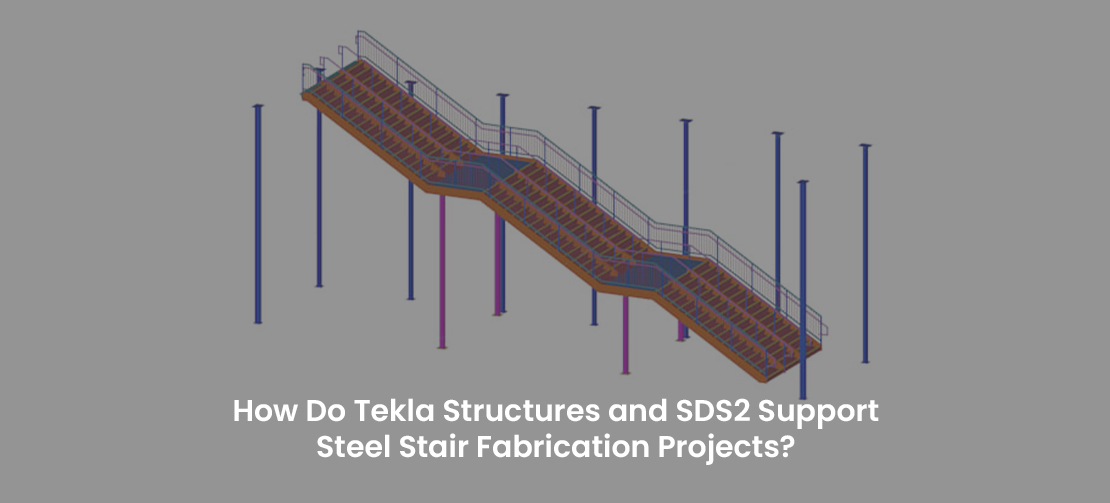
After material finalization, a 3D model is created using advanced software tools like Tekla Structures or STAAD Pro. This allows engineers to visualize the structure and ensure all components are properly aligned before fabrication.

Load simulation and stress analysis are then performed to identify weak points or high-stress zones. Based on these results, modifications are made to optimize structural performance.

Finally, fabrication drawings are generated with precise dimensions for manufacturing and site installation.

Key Engineering Factors in Staircase Design

Several important parameters influence the design of industrial steel staircases. The span between support plays a major role in determining beam strength. The angle of inclination affects user comfort and load distribution. Tread width and riser height must follow safety standards to ensure safe movement.

In addition, stringer design, weld strength, and joint detailing significantly impact overall stability. Engineers also consider anti-slip surfaces, especially in industrial environments where safety is critical.

Each of these factors is carefully balanced through steel staircase engineering services to ensure optimal performance.

Load Considerations in Industrial Staircases

Load distribution is one of the most important aspects of structural design. Engineers calculate how forces travel through treads, stringers, beams, and base supports.

Dead load remains constant throughout the structure’s lifespan, while live load varies depending on usage. Impact loads occur during movement or sudden force application. In some cases, wind and seismic loads are also considered, especially for exposed or tall structures.

A simplified overview of load considerations is shown below:

Summary Table

Load Type Description Engineering Consideration
Dead Load Self-weight of steel structure Constant structural load
Live Load Human and operational load Variable and dynamic
Impact Load Sudden movement forces Safety factor included
Wind Load External environmental force Applicable for exposed structures
Seismic Load Earthquake forces Region-based calculation

Role of Structural Software in Design

Modern engineering relies heavily on digital tools for accuracy and efficiency. Software like Tekla Structures helps create detailed 3D models, while STAAD Pro and SAP2000 are used for structural analysis.

These tools allow engineers to simulate real-world conditions and identify stress concentration points before fabrication begins. This reduces errors and improves safety outcomes in steel staircase load calculation and engineering services.

Material Selection in Heavy Load Applications

Material selection is a critical factor in staircase engineering. Mild steel is commonly used for general industrial applications due to its cost-effectiveness and strength. High-strength low alloy steel is preferred when higher load-bearing capacity is required.

In corrosive environments, galvanized or stainless steel is used to extend lifespan and reduce maintenance. The selection process is always aligned with environmental conditions and load requirements.

Connection Design and Structural Stability

Connections are the most sensitive part of any steel structure. In industrial staircases, both welded and bolted connections are used depending on design requirements.

Welded joints provide rigidity and strength, while bolted connections offer flexibility and ease of maintenance. Proper detailing of gusset plates, base plates, and anchor bolts ensures load transfer without structural failure.

Poor connection design is one of the most common causes of staircase failure, which is why it receives special attention in engineering services.

Safety Standards in Industrial Staircase Design

Safety compliance is a mandatory aspect of industrial engineering. Staircases are designed in accordance with IS codes, AISC standards, Eurocodes, and OSHA guidelines.

These standards define minimum requirements for load capacity, handrail height, tread dimensions, and safety margins. Compliance ensures that staircases meet both legal and operational safety requirements.

Challenges in Heavy Load Staircase Engineering

Designing industrial staircases comes with several challenges. Space limitations often require compact yet strong designs. High load requirements demand optimized structural sections. Exposure to chemicals or moisture can lead to corrosion issues.

Additionally, vibration from nearby machinery can affect structural stability over time. Engineers address these challenges using advanced simulation, material optimization, and precise detailing.

Benefits of Professional Engineering Services

Using expert steel staircase engineering services provides significant advantages in industrial construction. It ensures structural safety, reduces fabrication errors, and improves cost efficiency by optimizing material usage.

It also enhances compliance with international standards and extends the overall lifespan of the structure. More importantly, it minimizes risk during both installation and long-term usage.

Applications of Industrial Steel Staircases

Heavy-duty staircases are widely used across industrial sectors including manufacturing plants, warehouses, logistics centers, oil and gas facilities, and commercial complexes.

Each application requires customized engineering based on load requirements, environmental conditions, and usage frequency.

Why Gridsglobal for Staircase Engineering

Gridsglobal provides specialized structural engineering solutions with a strong focus on accuracy and performance. The company delivers end-to-end steel staircase load calculation and engineering services, ensuring that every design is optimized for safety, durability, and cost efficiency.

The engineering approach focuses on precision modeling, detailed analysis, and fabrication-ready outputs that reduce errors and improve project execution.

Conclusion

Designing steel staircases for heavy load industrial use requires a deep understanding of structural behavior, load distribution, material properties, and safety standards. It is not just a design task but a complete engineering process that ensures long-term safety and performance.

With increasing industrial infrastructure development, the demand for professional steel staircase engineering services continues to grow. Accurate load calculation and advanced structural design play a crucial role in building safe and efficient industrial environments.

Gridsglobal continues to deliver reliable engineering solutions that combine technical precision with practical construction needs, ensuring every staircase is built for strength, safety, and sustainability.

Frequently Asked Questions

What is steel staircase load calculation?

It is the process of analyzing all forces acting on a staircase to ensure it can safely carry expected loads without failure.

Why is load calculation important for industrial staircases?

It ensures structural safety, prevents failure, and maintains compliance with engineering standards.

What software is used in staircase engineering?

Tekla Structures, STAAD Pro, SAP2000, and AutoCAD are commonly used tools.

What materials are used in heavy-duty staircases?

Mild steel, high-strength steel, galvanized steel, and stainless steel are commonly used.

What loads are considered in staircase design?

Dead load, live load, impact load, wind load, and seismic load are considered depending on conditions.

How do engineers ensure staircase safety?

By using accurate load calculations, structural analysis, and compliance with design codes.

What standards are followed in design?

IS codes, AISC standards, Eurocodes, and OSHA guidelines are commonly followed.

Can industrial staircases carry machinery load?

Yes, if they are specifically engineered for heavy-duty applications.

What is the role of connection design?

It ensures safe transfer of loads between structural members without failure.

Why choose professional engineering services?

They ensure accuracy, safety, cost efficiency, and long-term structural performance.