Key Error-Reduction Benefits
| Detailing Area |
Common Fabrication Risk |
How Professional Detailing Helps |
| Dimensions |
Incorrect cutting or assembly |
Provides accurate fabrication dimensions |
| Connections |
Incorrect holes, bolts, or welds |
Clearly defines connection requirements |
| 3D Coordination |
Member clashes |
Identifies conflicts before fabrication |
| Material Information |
Incorrect material selection |
Specifies grades, sizes, and quantities |
| Shop Drawings |
Missing or conflicting information |
Provides fabrication-ready documentation |
| Erection |
Installation difficulties |
Clarifies member orientation and assembly |
| Revisions |
Outdated fabrication information |
Maintains coordinated drawing revisions |
Why Is 3D Steel Detailing Important for Texas Projects?
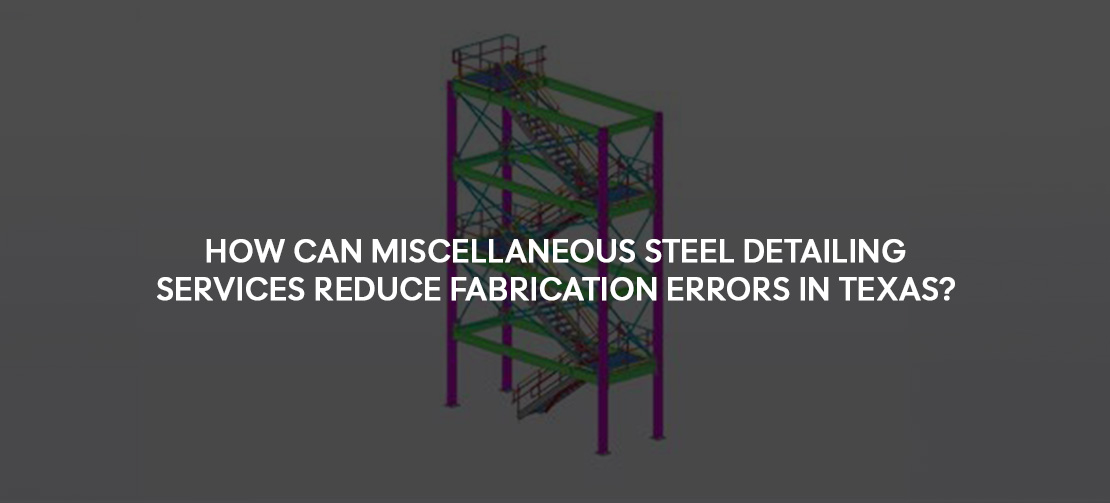
3D steel detailing provides a comprehensive digital representation of the steel structure before fabrication begins. Software such as Tekla Structures, SDS2, AutoCAD, Revit, and Advance Steel can be used to develop detailed models and drawings depending on project requirements.
A coordinated model helps detailers examine member relationships, connection geometry, elevations, clearances, and interfaces with other building systems. For complex Texas projects, this approach can be especially useful when multiple contractors and fabrication teams are involved.
A well-coordinated model provides a common reference point and helps reduce ambiguity throughout the construction process.
How Does Detailing Improve Fabrication and Erection?
Fabrication and erection are closely connected. A component that is technically correct but difficult to install can still create problems on site. Professional detailing considers both fabrication and erection requirements.
Member marks, piece identification, assembly drawings, erection drawings, bolt information, weld requirements, and orientation details help fabricators and erectors understand how individual components fit together.
For miscellaneous steel, this is particularly important for stairs, platforms, ladders, handrails, and equipment supports because these components frequently require precise field alignment.
Supporting Quality Control Before Fabrication
A professional detailing workflow can include multiple checking stages before drawings are released for fabrication. Detailers can review dimensions, connections, member specifications, model coordination, drawing consistency, and revision information.
This pre-fabrication checking process creates an opportunity to identify errors while they are still digital rather than after steel has been cut or assembled. The earlier an error is identified, the lower the potential cost of correction.
Why Choose Gridsglobal for Miscellaneous Steel Detailing?
Gridsglobal Detailing provides professional steel detailing support for contractors, fabricators, engineers, and construction companies working on projects in the USA and Canada. Our detailing workflow is focused on accuracy, coordination, constructability, and fabrication requirements.
Depending on project requirements, our team can work with platforms including Tekla Structures and SDS2 to develop detailed models and fabrication documentation.
Our services can support miscellaneous steel components such as stairs, platforms, ladders, handrails, equipment supports, brackets, embeds, canopies, and other secondary steel elements.
By integrating model-based detailing with systematic drawing checks, Gridsglobal helps clients reduce fabrication uncertainties and improve coordination between engineering, fabrication, and erection teams.